The Diecast Zone · Model Car Club Since 1994
Diecast Collector Forums
Eight forums, every scale, and thirty years of shop talk — new arrivals, restorations, reviews, and the finds you won’t see posted anywhere else, with the full archive back to 2002 restored and searchable. Free to Register.
8Forums
195,000+Topics
1,276,000+Posts
10,000+Members
Notifications
Clear all
Forum 18
12
Posts
5
Users
19
Reactions
2,542
Views

Topic starter
31/08/2024 11:52 am
The first and fastest way to tell a Porsche 956 and a Porsche 962 from each other is:
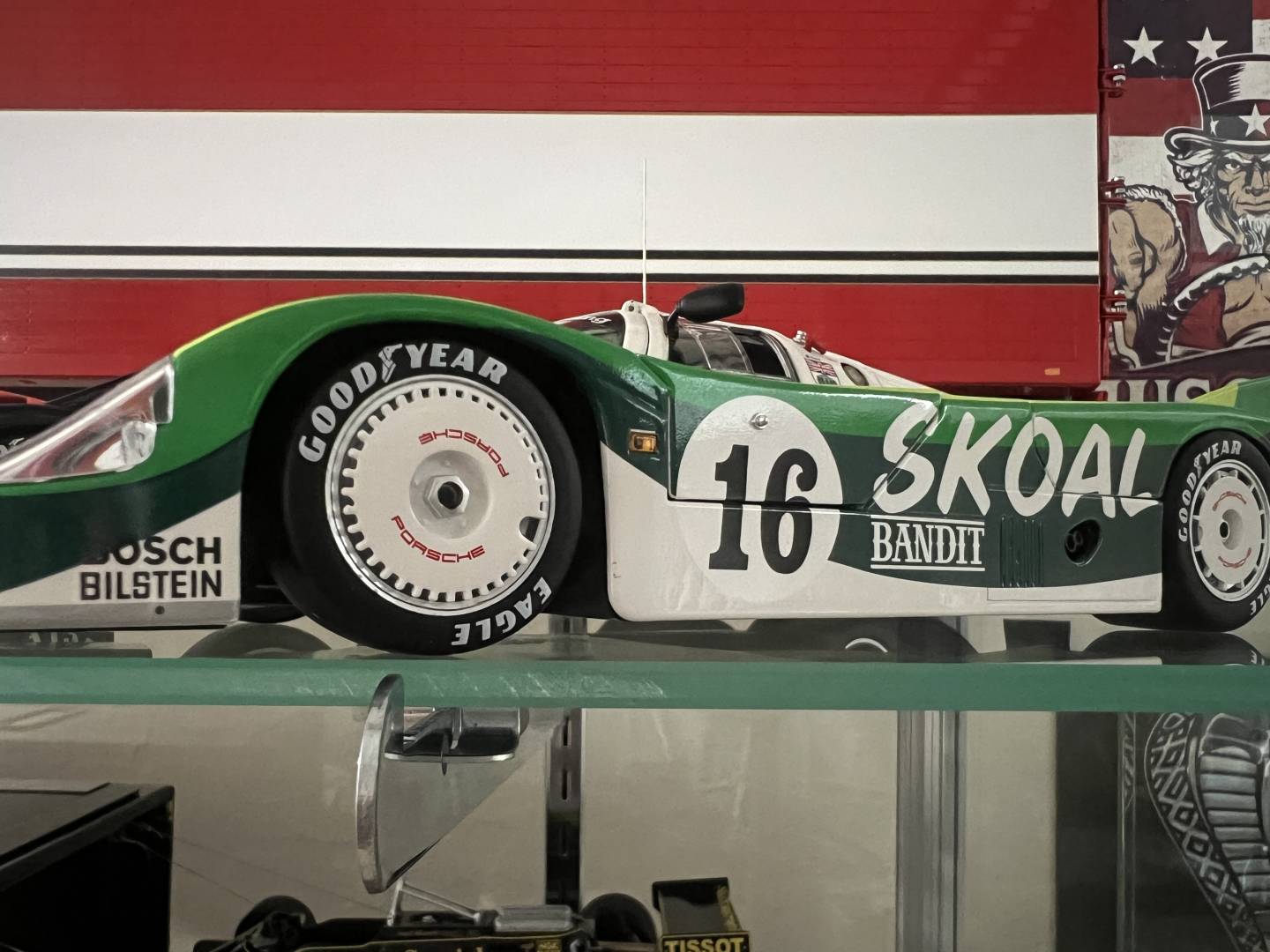

1. Look at the space between the front of the door and the rear of the fender opening, the Porsche 956 will have less space, see the Skoal 956 vs the Jagermiester 962, the 962 the space from the front door to the opening of the rear of the fender opening is longer.


2. The second way you can tell is look at the front of the Rothmans Porsche 956 and see how where is says Dunlop it is thicker, where on the Budweiser Porsche 962 it is thinner.

3. Another thing you can look for is the slope of the front end from the windshield to the nose, the 956 has a shorter slope while the 962 the slope is longer, this third one is harder to tell without the cars being next to each other, also the Rothmans 956 the headlight glass goes to the edge of the front while the Budweiser 962 there is a little space from the headlight glass to the front edge of the car.

Topic starter
01/09/2024 8:38 am
@chris I learned this in an article about the Porsche 956 and 962, the article talked about how to tell the two apart with the real cars.
Christopher Moroni and Tony Perrone reacted

01/09/2024 9:47 am
Thanks! I would've never known this....
Me too!
I thought one had to pick them up, turn them over and read what year they were. (Scale and real cars too! HA!)
Topic starter
01/09/2024 11:57 am
1982 and 1983 are the years Porsche built the 956 models due to IMSA rule changes and the FIA was late to follow IMSA on some of the rule changes is when Porsche came out with the updated 962. One of the biggest changes to the cars was moving the foot well and pedals from in front of the front axle to behind the front axle for more driver safety. IMSA also required the exhaust to exit out of the back of the car while the FIA allowed the exhaust to exit out the side of the car. IMSA also only allowed a single turbo in the new rules package. The FIA rules had allowed twin turbos.
Sadly FIA going to 3.5 liter engines like Formula One was using caused the Group C/IMSA series to die, it was not as simple as just taking a Formula One 3.5 liter engine and putting into a Group C/IMSA car, the Formula One engines were only designed to last for 250 miles and Group C/IMSA were endurance races, the engine change to 3.5 liter engines turned the series into sprint races and drove away the fans of both Group C and IMSA. Only Peugeot fully went all in on developing a 3.5 liter engine while the other manufactures decided it was not cost effective to spend millions of dollars to manufacture and develop a 3.5 liter engine, Porsche, Jaguar, Mercedes and even Mazda walked away from the series.
David Green and Tony Perrone reacted

02/09/2024 1:47 pm
As a result of your post, I learned some differences that I didn't know as well. I'd add that the cabin intake inlets below the windshield are shaped differently. The 956 has two individual air inlets, and the 962 has one. I'm using John's photo to demonstrate the differences.

Another difference between the 962 from the 956 is that the 962 usually (not always) has a large air intake scoop on the engine cover.

David Green and Tony Perrone reacted
Topic starter
02/09/2024 3:27 pm
The large intake scoop on the engine cover I think was on the IMSA series cars due to the different engine rules, IMSA required the exhaust to exit out the rear and limited the engine to a single turbo charger, where the FIA Group C cars continued to have the side exit exhaust. I think the engine cover scoop helps to remove exhaust and engine heat as the turbo charger would be located in the center and up high and the exhaust exits in the center up high as well.
The group C cars were twin turbo with the exhaust mounted low and exiting out the side in front of the rear tires.
That is my theory on the reason for the engine cover scoop on the IMSA cars.


The BFGoodrich 962 is a 1986 and the Bayside Disposal Racing 962 is a 1987.


The Jagermeister 962 is a 1986 and the Camel 962 is a 1988.
David Green and Tony Perrone reacted
Topic starter
02/09/2024 3:37 pm
I don't think you can use the air intake under the windshield as a identifying mark:


The 1988 Camel 962 Group C car has the single air intake under the windshield while the 1986 Jagermeister 962 Group C car has the split air intake under the windshield.

The 1990 Kenwood 962 short tail Group C car also has the split air intake under the windshield so it looks like the Group C cars can have either the single air intake or the split air intake under the windshield.
The IMSA cars from the ones I have seen all have a single air intake under the windshield.
David Green and Tony Perrone reacted

03/09/2024 12:08 am
@john3976 - I've not seen a 956 with the single air inlets. All I've seen have the two inlets. Although the 962 usually has one inlet after doing more research I've seen a few with two as well.
Tony Perrone reacted
Topic starter
03/09/2024 6:08 am
@marty-johnson I have only seen split intakes on the 956 under the windshield. The 962 however many teams built their own cars from tubs and wrecked 962's that may be why the air intake scoop can be split on some 962's.
I solved the issue of the huge engine cover scoop as well, it was there to feed the intercooler for the intake charge after the turbo charger and the exit at the bottom/back of the scoop helped pull the air out including the heat from the turbo charger. Here is a photo of the engine without the engine cover showing the large intercooler.


Later this week or next week I will do a video of the 1/18 scale version of this Miller sponsored car. This one is next to impossible to find in 1/18 scale, you can find it in 1/43 scale for around $200 dollars but the 1/18 scale versions are very rare to find.
Marty Johnson reacted
03/09/2024 11:57 am
@john3976 - Now THAT is an intercooler! Sheesh! That thing is HUGE!
Well done on finding the answers to both questions!
Tony Perrone reacted