The Diecast Zone · Model Car Club Since 1994
Diecast Collector Forums
Eight forums, every scale, and thirty years of shop talk — new arrivals, restorations, reviews, and the finds you won’t see posted anywhere else, with the full archive back to 2002 restored and searchable. Free to Register.
8Forums
195,000+Topics
1,276,000+Posts
10,000+Members
Notifications
Clear all
Forum 43
6
Posts
6
Users
10
Reactions
1,257
Views

Topic starter
17/08/2024 10:54 am
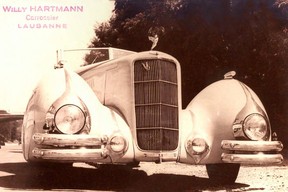
The 1937 Cadillac Hartmann Cabriolet has quite a nefarious history. I begins with wealthy playboy Phillipe Barraud snagging one of two Cadillac V16 chassis sent to Europe planning to commission the most audacious Art Moderne coachwork on the Continent. Being Swiss, he sent the chassis to Willie Hartmann in nearby Lausanne for the coachwork so he could oversee the work. The result was a stretched 22' long Deco cabriolet that with the Caddy's 452 cid V16 was sure to be a show stopper wherever he went. On the redesigned dash was a triangular shaped Cadillac emblem inscribed "Carrosserie Hartmann, Lausanne. Cadillac". The overall design of the car mimicked the designs of French coachbuilder Figoni et Falaschi. Barraud drove the car for two years and then had it stored away for ten with the advent of WWll. He finally had it retrieved, repainted it and added bullet driving lights and a full width front bumper. Moving ahead to 1968, the car was found in a field and was sold for $925. The car went through several hands with the consensus being it was a Figoni et Falaschi build. The third owner, Andre Lecoq of Paris restored and highly modified the car including new bumpers, a plate covering the folded top, a recessed grill and added lower trim. The Hartmann/Cadillac badging was removed and a replica Figoni et Falaschi unit. Advertised as a "Figoni et Falaschi", it was sold at Barrett-Jackson for $1.4 million painted "resale red". It now sits in the Bkackhawk Collection with Willie Hartmann's plaque back on the dash. I haven't found any repercussions over the obvious misrepresentation if only for the amount of the winning bid. I assume the fake F&F provenance was done to boost its value especially with the car being far from original when auctioned.


Original state:


17/08/2024 12:52 pm
Thanks for the car’s history. This car would be a standout in any collection, whether 1940 or 2024.
Ed Davis
Inverness, Illinois, USA
John Kuvakas and Rich Sufficool reacted

Topic starter
17/08/2024 7:19 pm
@lloyd-mecca Switching the Hartmann plaque for a replica F&F and then promoting it at auction as an F&F would seem like fraud. Despite the fact that when that car was found in 1968, there were those that thought it was, the true nature of the original build was known to the seller.
John Kuvakas reacted


17/08/2024 7:25 pm
Fascinating story. Is it possible that B-J thought the car was indeed a Figoni et Falaschi with the wrong plaque installed somewhere along the line? Were they just, in their minds, being true to the car's lineage?
BTW, the EMC version of this model in red is white-metal.
John Kuvakas
Warrenton, VA

17/08/2024 10:47 pm
An excerpt from Driving.ca published in 2019.........
" Barraud wanted a car built in the style of the very popular Figoni et Falaschi carrosserie, but commissioned a lesser-known coachbuilder down the street from him, Willy Hartmann, to assemble the body because Barraud wanted to closely supervise its construction.
He needn’t have worried—Hartmann delivered. The French, flowing lines on the fenders he hand-shaped were complemented by the finest componentry – Marchal and Bosch lighting; a custom, finned grille – and, of course, that 452-cubic-inch Cadillac V16 engine, fitted with dual everything, from the twin exhaust to the twin ignition.
If that somehow failed to impress, the sheer size of the car would certainly do it. The two-seater’s titanic 22-foot length was visually exaggerated by a radiator and firewall cut down three to four inches, which lowered the hood-line. When Hartmann finished the Cadillac, it weighed in at around 6,000 lbs, and required special reinforcements and heavy-duty springs to handle the tonnage.
Article content
 ?w=576&crop=1&strip=all&quality=90&sig=EG82P_97dHyH3N4Za1PU2A 2x" />
Larger than Life
“It was almost bigger than the Swiss streets at the time could handle,” says Don McLellan, president of Chatham, Ontario-based RM Restoration, which led the recent two-year effort to return the car to original condition.
McLellan had to correct the several changes made to the car after 1968. It was that year a mechanic friend that Barraud had asked to store the classic – then in need of much work – instead sold it for a pittance without telling him.
The car had traded hands several times by the time McLellan saw it, spent a long stint in the Blackhawk Museum in California, and at some point saw its lights and bumper modified. In the ’90s, under the ownership of Tom Barrett of Barrett-Jackson, the car was repainted in red, with chrome embellishments stuck to its flanks. Barrett apparently even fixed a Figoni et Falaschi badge on it in an effort to bump up its value. "
If there is fraud, this is debatable but certainly manipulation of facts about its origins.
Topic starter
18/08/2024 10:53 am
@jkuvakas I assume they took the consignor's word for it. The truth was known to a few but B-J didn't do enough vetting to even raise a question on the car's provenance. If it turns out that B-J was responsible for placing the F&F plaque on the car, then they are complicit in the fraud.
18/08/2024 12:51 pm
@rich-sufficool, you're right about that! It's on them either way.
John Kuvakas
Warrenton, VA
Rich Sufficool reacted

22/08/2024 4:03 pm
@jkuvakas Really? I thought all EMCs were resin. If white metal, that's news to me.