The Diecast Zone · Model Car Club Since 1994
Diecast Collector Forums
Eight forums, every scale, and thirty years of shop talk — new arrivals, restorations, reviews, and the finds you won’t see posted anywhere else, with the full archive back to 2002 restored and searchable. Free to Register.
8Forums
195,000+Topics
1,276,000+Posts
10,000+Members
Notifications
Clear all
Forum 43
10
Posts
8
Users
53
Reactions
577
Views


06/08/2026 3:26 pm
Little Boy (and Fat Man) helped avoid a very costly final battle on the home islands and thus actually saved many lives.


07/08/2026 2:09 am
As far as I know Brumm made these bombs in 1/43.

07/08/2026 5:36 am
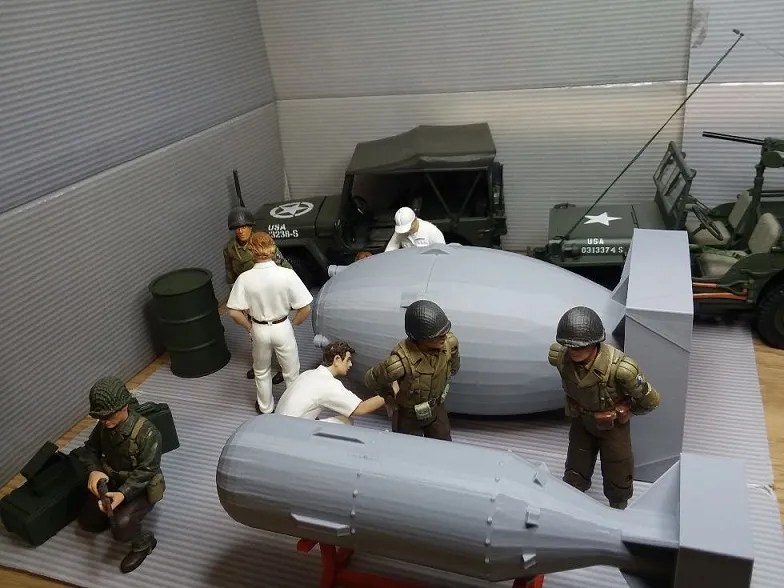
Yep.... that's an excellent 1/43 replica of Little Boy Harv. Their complimentary Fat Man diorama is also nice. These two models inspired me to have 1/18 scale versions printed up years ago. Unfortunately, I've yet to "finish them properly." They're still in the some-what ruff 3-D printed stage - but you get the idea.
As Mike noted, their historical importance cannot be overstated.


07/08/2026 8:50 am
Not so happy for Japan, but it may have saved lives overall. Impressive displays, Harv and Chris.

Topic starter
07/08/2026 4:44 pm
I may as well jump ahead to August 9. Here's Brumm's model of the 'Fat Man' plutonium bomb, dropped on Nagasaki from the B-29 Bocks Car, piloted by Major Charles Sweeney. Someday perhaps we will find out why Brumm made these - quite a departure from their long list of diecast cars.


In 2002 there was a reunion of anyone left from the 509th Composite Group plus the WAC pilots who ferried unarmed B-29s across the Pacific to secured airfields. Brave ladies! Dutch Van Kirk, the Enola Gay navigator was there signing the photo from my post above (the two pilots, Sweeney and Col. Paul Tibbets, had signed ahead of time). As many of you know, Oak Ridge produced the enriched uranium used in Little Boy. Today, the K-25 Gaseous Diffusion plant is long gone with various next-gen nuclear power equipment factories springing up on the property. The Y-12 National Security Complex handles nuclear weapon component maintenance and safeguards our weapons-grade material stockpile. The X-10 facility, now known as the Oak Ridge National Laboratory, is involved in all kinds of research, high energy physics, and isotope production.
There's been a lot of post-1945 armchair quarterbacking about the dropping of the two bombs. It's obvious they brought the war to a speedy conclusion and in the long run, saved more lives than were lost. The Japanese had been brainwashed into thinking Hirohito was a god, and that US marines would do unspeakable things to their women and children, even driving them to suicide. One cannot ignore the politics of the time either - the cost of development was about a billion dollars - 1940s dollars!. Though the original plan was to drop one on Germany, they surrendered before that could happen. Someone wanted to see a return on that expenditure. Then there was the choice of targets. Some argued for a blast over Mt. Fuji, thinking the resulting snow evaporation would convince Japan to give up. There were also voices wanting an undisturbed city to be destroyed to assess total damage. Though by July a successful test in New Mexico showed that the device would work, more info was needed - what altitude to detonate, blast radius, etc. And of course the effects on the population.
But there was one undeniable result. Pick a fight with the USA and the results for that country will be regime-ending.
07/08/2026 7:06 pm
Something not often talked about was Japan’s atomic bomb program. They actually had two programs, one by their army and one by their navy. They were actually ahead of Germany. If you search on the internet you can read about it.
Ed Davis
Inverness, Illinois, USA
