The Diecast Zone · Model Car Club Since 1994
Diecast Collector Forums
Eight forums, every scale, and thirty years of shop talk — new arrivals, restorations, reviews, and the finds you won’t see posted anywhere else, with the full archive back to 2002 restored and searchable. Free to Register.
8Forums
195,000+Topics
1,276,000+Posts
10,000+Members
Notifications
Clear all
Forum 43
7
Posts
6
Users
17
Reactions
801
Views

Topic starter
22/08/2026 9:47 am
How a childhood fascination with Dinky Toys, a craftsman’s curiosity, and a lifelong eye for detail shaped John Roberts into one of the hobby’s most respected collectors
Anyone familiar with Brooklin Models is likely to know the name John Roberts. Over the years, John has earned a reputation as one of the hobby’s most knowledgeable Brooklin collectors, particularly admired for the custom builds and recolors that have transformed familiar standard issues into something distinctly his own. His models reflect an encyclopedic knowledge of the subject, but also something more difficult to define. Instinct. He knows what looks right.

That instinct did not begin with Brooklin. It did not even begin with collecting in the way most adults would understand the word. It began with a little boy and a toy car.
“I was told that the first word I spoke was ‘car,’” John says. “Apparently I was a car nut from the very beginning.”

(a reimagining of John’s early days of collecting)
By the time he was five, model cars were already part of his world. In Britain in the early 1950s, that meant Dinky Toys. John cannot remember his first one, but certain models remain remarkably clear in his memory, including a double-decker bus, a Hillman Minx and an OXO-liveried Trojan van.
The Trojan in particular carries a memory far beyond the model itself. John was staying with his mother at his grandparents’ home in Ammanford, South Wales, when his grandmother returned from town with the little Dinky van. As a child, John naturally remembered the toy. Only later did he understand the circumstances surrounding the visit. His mother was there helping care for John’s grandfather, who was dying of silicosis after years working underground at Betws Colliery. It is one of those memories in which a model car becomes more than an object. It fixes a moment in time, preserving details that might otherwise have disappeared.
The Hillman Minx has similarly deep roots. When John was born in Auckland, New Zealand, his father hired a Hillman Minx to collect his wife and new son from the hospital. John obviously has no memory of the ride, but his father later told him the story. He also remembers that his father always wanted a Hillman of his own. “I guess this is where my interest in Rootes Group cars comes from,” John says.
With a collector’s instinct for revisiting details, he has even reconsidered the story over the years. Perhaps, he wonders, the car was actually a Humber 10, essentially a Minx with a different grille and a plausible possibility in New Zealand at the time. That kind of question is quintessentially John Roberts. Even a family story from infancy is subject to further research.
The Playground Experts
Collecting soon became a social activity. At school, John and his friends pushed their Dinkys along the flat stone top of a low wall separating the playground from the neighboring church. The cars received hard use, often losing their rubber tires, and generations of play eventually wore two parallel grooves into the stone.

(It might have looked something like this)
The school itself was converted into private homes years ago, but when John returned roughly a decade ago, the wall was still there. So were the grooves. “I doubt anyone from more recent times knows why they are there,” he says. For John, they are tracks left by an earlier generation of collectors.
The boys were not casual observers, either. They knew the ranges, anticipated new releases, and debated their merits. Each month brought speculation about what Dinky might introduce next. A fortunate few might arrive at school with the newest release, while everyone else waited for a birthday, Christmas, or the timely appearance of what John calls “a benevolent relative.”
And they were critics. John specifically remembers the group taking issue with the Dinky Ford Zephyr because the rear window was the wrong shape. The Vauxhall Cresta came under scrutiny because it lacked a badge and hood ornament. These were children discussing toy cars, but the habits were already forming, comparing the miniature with the real thing, noticing what the manufacturer got wrong, and imagining how it might have been done better.


For John, the next logical step was apparently to correct matters himself. At about seven years old, he discovered a hacksaw in his father’s shed. Before long, his Hillman Minx and Ford Zephyr had both become convertibles. “This was the beginning of a very dubious approach to collecting,” he says. Decades before John became known for modifying Brooklin Models, he had already decided that a factory-issued model did not necessarily have to remain the way the factory made it.
Discovering a Bigger World
For years, Dinky remained the center of John’s collecting universe. Then a schoolmate introduced him to something unfamiliar — a Buick Roadmaster. Despite various offers, its owner refused to trade. The model belonged to his older brother, John was told, and the family was keeping its “French Dinkys.”

John had never heard of French Dinkys. A new trail had opened. He soon learned that the French models were highly prized. They were scarcer, more expensive and, in the opinion of many British collectors, sometimes better than their domestic counterparts.
Then, in 1956, another revolution arrived. Corgi Toys appeared, famously promoted as “the ones with windows,” and the playground conversation changed again. Every Monday, John and his friends gathered to report what they had spotted in the windows of their local toy shops over the weekend. “Ah…toy shops,” John says. “Those were the days.”
The hobby was expanding around him, and so was his understanding of what a model car could be.
Learning to Build
Although diecast models had captured John first, his teenage years brought another education with 1/32 plastic kits. Airfix dominated because they were affordable, although the occasional Revell or AMT American car kit was an especially welcome treat. John remembers the 1956 Ford Fairlane and, particularly fondly, the 1956 Buick. “I think that is still my favorite,” he says.
Like most young builders of the era, his first attempts were less than museum quality. But repetition brought skill, and Airfix kits gave him enough opportunities to practice. More significantly, John found it difficult to build anything exactly as the instructions intended. Opening panels appeared. Engines were added. Bodies were altered. Even an Airfix 1930 Bentley became a candidate for substantial modification.

A book titled Plastic Model Cars by Cecil Gibson became an important influence. Gibson concentrated heavily on Merit racing car kits in 1/24 scale, which were both larger and more expensive than John preferred, but the principle behind the book mattered more than the particular subjects. A kit was a starting point.
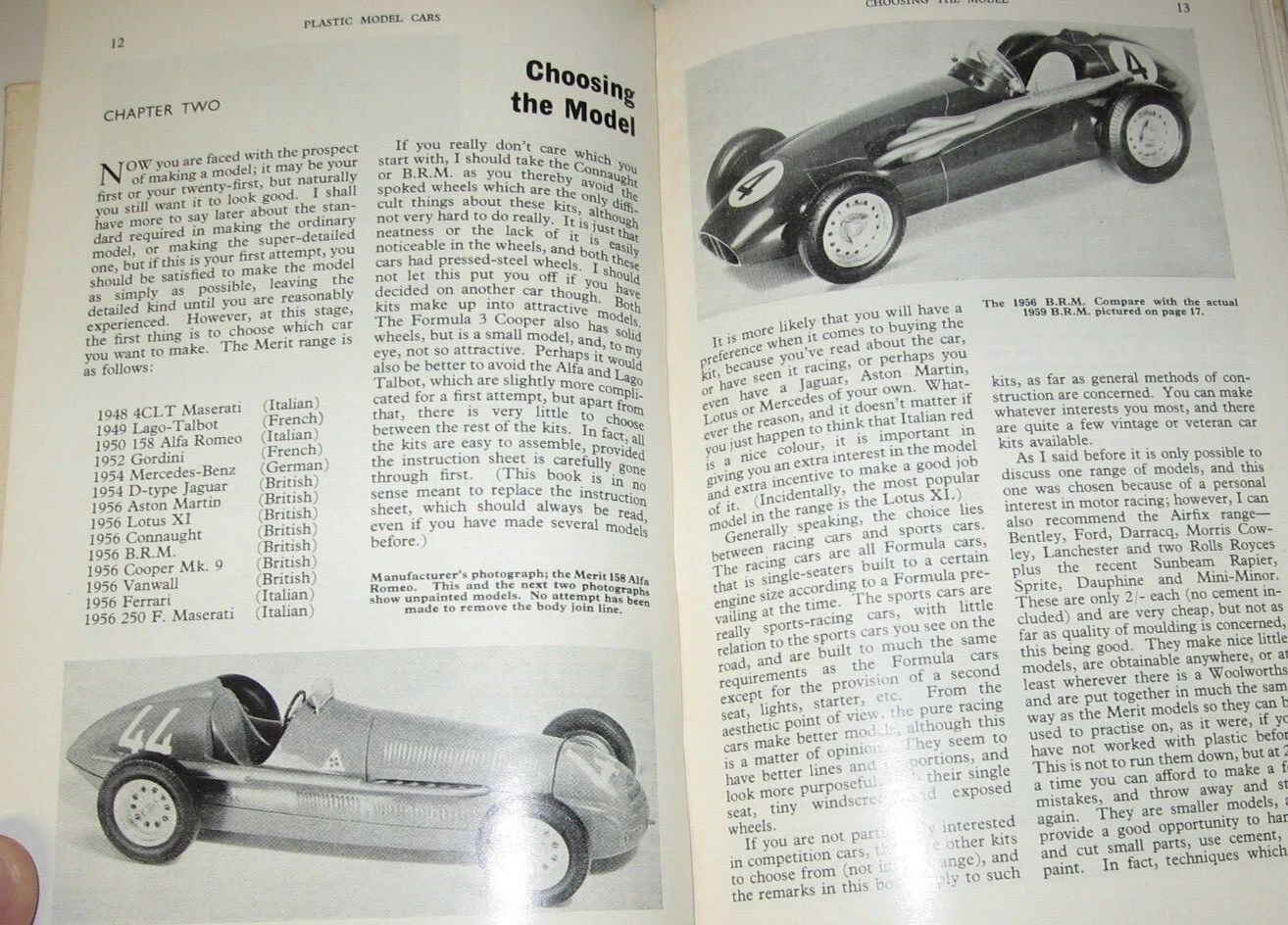
By his teenage years, John’s abilities had advanced enough that a local racing driver commissioned him to build an Austin-Healey Sebring Sprite. It became John’s first paid modeling commission. The skills developed through those plastic kits — preparation, painting, modifying, and seeing beyond the components supplied in the box — would prove invaluable when white metal models entered his life.
The Collector Returns
During the Airfix years, diecast collecting had receded somewhat, but it never disappeared. At college, John continued picking up the occasional Dinky. In Exeter, he discovered a shop with old stock and bought several pieces, among them a yellow Dinky Singer Vogue. At the time, he thought little of it.

Years later, the model went to Vectis Auctions, where the proceeds were substantial enough to pay for a family holiday. “Looking back I wish I’d kept it,” John says, before adding what might be one of the most universal sentiments in the entire collecting hobby: “That probably goes for a lot of models over the years.”
When John turned 21, he marked the occasion by ordering two models advertised in Model Cars magazine, a Politoys Lamborghini 350 GT and an Alfa Romeo Canguro. He had seen photographs but never the models themselves. They were expensive, but they were also a revelation. “They were streets ahead of anything we were producing here.”

By then, plastic kits were surrendering first place again to finished diecasts. There was no rigid collecting theme. Solido became a particular interest, along with some of the more obscure Continental manufacturers finding their way into Britain through specialist importers. Names such as Tekno, Märklin, Lion Car, Winross, and Diapet began putting pressure on John’s wallet.
They also brought him into contact with people who would shape the next stage of his collecting life. One was Barry Lester. At the time, Barry was a part-time dealer handling many of the unusual imported models that fascinated John. John already knew his name from articles Barry had written for Model Cars on constructing models from wood, articles that had inspired John to try the technique himself.
“I had a spell of making models in wood as he was an inspiration,” John recalls. “He was also a lot better than me.”
On one of John’s regular visits, Barry showed him a new venture in Auto Replicas white metal kits. Alongside the kits, Barry produced small numbers of fully finished examples. For John, another door had opened.
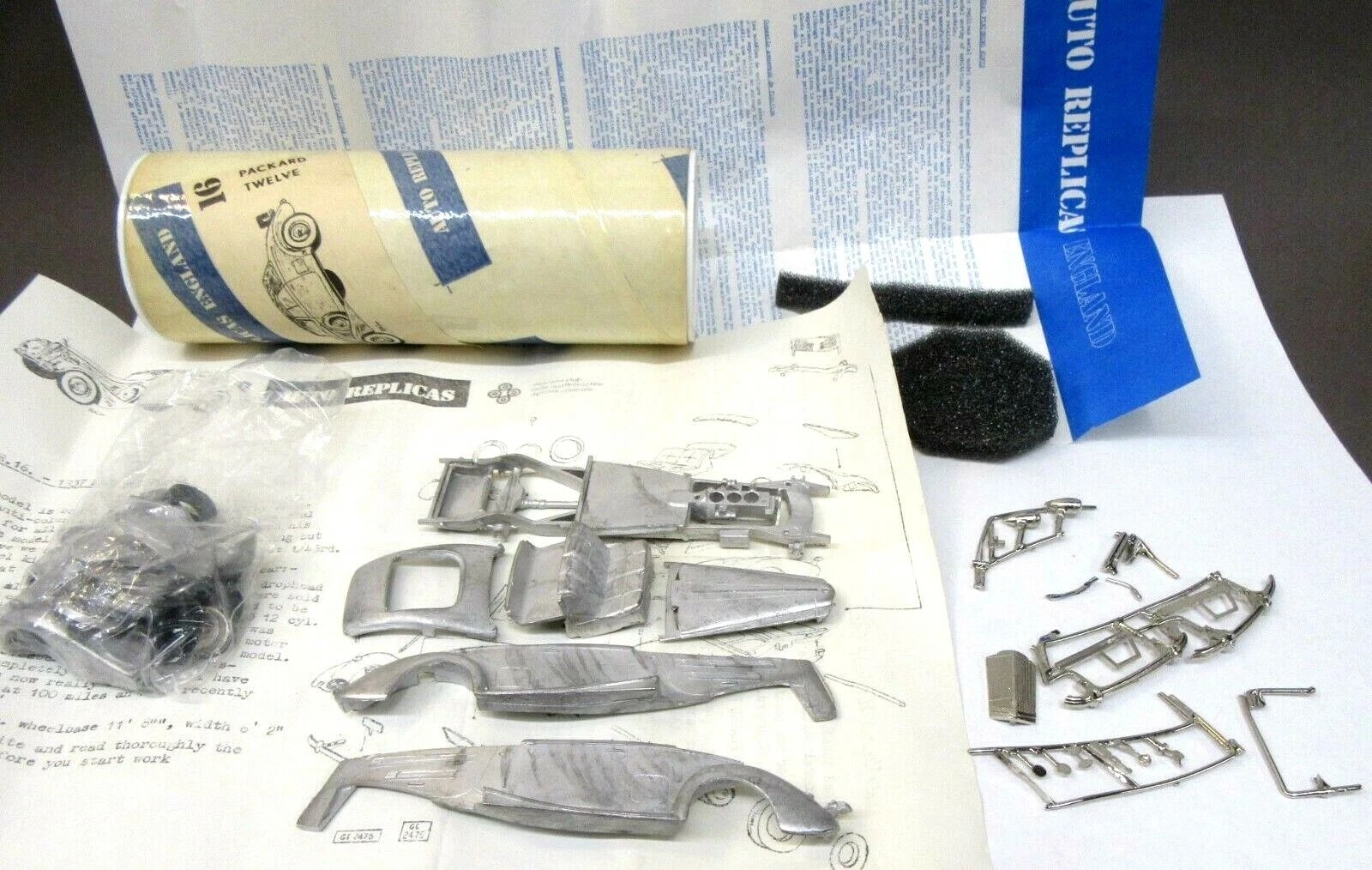
White Metal Changes Everything
John’s first effort with white metal was an AC Cobra kit. Back home in North Wales, he began cleaning the castings with emery paper, applying the enthusiasm of a model builder accustomed to more forgiving materials. He quickly discovered just how soft white metal could be. “My Cobra was in danger of becoming a Healey Sprite!”
He persevered. Next came a Western Models kit of a 1937 Bentley. “The white metal bug well and truly bit.” The medium suited him. White metal models invited examination, craftsmanship and, perhaps most importantly for John, possibilities.
An Artist’s Eye
John’s creative interests were never confined to three dimensions. During the early 1970s, much of his spare time was devoted to painting images of cars, usually in oils. What began as another interest became serious enough to lead to several one-man exhibitions and even the possibility of a professional career.


Reality eventually intervened. With a mortgage and an infant son, John concluded that the security of teaching was preferable to the uncertain life of a motoring artist. Still, his artwork created experiences he remembers vividly.
The Northern Guild of Motoring Writers commissioned him to paint a Century motor car for presentation to the chairman of the Society of Motor Manufacturers and Traders at the Earls Court Motor Show in London. His work led to a brief appearance on BBC television news.
He also met future Formula One World Champion James Hunt. A local motoring writer had telephoned John asking whether he had a painting of Hunt’s racing car. He did not, but quickly produced one and was subsequently invited to present it to Hunt, who was touring the country on behalf of Vauxhall.
John remembers Hunt being chauffeured around in one of the least glamorous possible choices for a future World Champion: a Vauxhall Chevette. Hunt was tall. The Chevette was not. John still remembers how uncomfortable he looked folded into it.
Even John’s painting eventually circled back to the model world. He produced artwork for Barry Lester that appeared on Auto Replicas packaging. Years later, his illustrations would also appear on boxes for WMTC Brooklin club specials. John’s eye for proportion, color, and detail was being trained not only through modeling, but through studying cars closely enough to paint them.
A Way With Words
Painting was not John’s only creative outlet during his years in education. He also became a published children’s author, although that career began less as an ambition to write books than as a way to teach creative writing.
John would begin a story himself and read the opening to his class, then encourage the children to continue it in their own way or use it simply as a starting point for an entirely different adventure. The approach worked. Before long, John had carried one of his own stories through to completion, then wrote three more.
One of those books, Claude the Crab, was accepted by a local publisher and proved fairly successful. John also illustrated the book himself, giving him another opportunity to combine writing and artwork. The story was set in the North Wales town of Llandudno, a place with deep family connections. John’s father was born there, while his mother spent most of her early years there. It was also where his parents met, adding another personal layer to a story that had already grown out of John’s experiences in the classroom.


John attended several book fairs as an author, talking with children about his work. For a time, he imagined that writing might eventually sit alongside model making as part of his life after teaching. But it didn’t quite work out that way.
“I simply didn’t have the time to do both,” John says. More importantly, once he left education, he discovered that much of the inspiration for the stories had left with it. The children had been his inspiration, and without the daily interaction of the classroom, the impulse to write children’s fiction faded. His period as a children’s author was relatively brief.
His writing did not disappear, however. It simply followed him into the model world. John wrote extensively for Brooklin, contributing articles to the company’s annual catalogues and writing the descriptive text that accompanied the models.
There were articles for the Brooklin Collectors Club magazine as well, along with contributions to the Wessex Model & Toy Collectors’ Smalltalk magazine. “I enjoyed my writing spells,” John says.
In retrospect, the writing belongs naturally alongside the painting and model building. Whether working with words, oils, wood, plastic, or white metal, John seems always to have been drawn toward the same thing… taking an idea and giving it form.
The Road to Brooklin
By the time Brooklin Models entered John’s life, decades of collecting, building, modifying, and painting cars had prepared him for it without his knowing. Brooklin brought those interests together.
John’s relationship with Brooklin itself began in an appropriately unplanned fashion. He had been building a few models in wood and had reached the point where two of them — a 1955 Buick convertible and a 1954 Cadillac 75 Fleetwood — needed wheels and steering wheels.

(A 1931 Packard with a custom Aerocar carved by John)


(An example of another wooden car carved by John - Babs, the land speed record car driven by Parry Thomas. This one borrowed wheels from Western)
At the time, John was head of a primary school near Melksham. He realized that the Brooklin factory was not particularly far away and decided there was no harm in asking. He telephoned. John Hall answered. After John explained what he needed, Mr. Hall invited him to the factory.

So John made his way to the Pines Way Industrial Estate, where he found Brooklin tucked into the left-hand corner of the site. In those days, John Hall’s office and workshop were immediately to the right of the entrance, in a space that would eventually become the reception area.
Mr. Hall welcomed him warmly, then looked at John’s wooden models. “If you could work in brass, he would give me a job!” John remembers. There was only one difficulty. “Unfortunately I’ve never mastered working in brass,” he says, “leaving that to the skillful folk.”
What might have been a quick visit to obtain a few parts instead turned into a long conversation about cars and model cars. “Me talking too much as usual,” John recalls.
He had brought one of his paintings, this one of a 1942 DeSoto, and gave it to John Hall. In return, Mr. Hall presented him with BRK 20, the Buick Skylark, which was just about to be distributed to dealers. John also got the wheels he had originally gone there to obtain.

It would have been a memorable enough visit even if that had been the end of the story. It was not. “John asked me to keep in touch, which I did,” John says, “although I never expected my relationship with Brooklin to last so long or play such a large part in my life.”
Interestingly, even John cannot say with certainty whether the Skylark was his first Brooklin. He believes he may already have owned one or two. In a collecting life approaching three-quarters of a century, some details understandably blur. What did not blur was the friendship.
More Than a Collector
John remained in regular contact with John Hall, and before long Mr. Hall called and asked him to visit the factory again. This time he had an idea to discuss. He wanted to create a new line of British cars to complement Brooklin’s established American subjects.
As John remembers it, the origins of the idea may have involved conversations with John Hammick and John Martin, who had considered producing a British range that might have been called Westminster Models, with Brooklin potentially involved in manufacture. John is careful about presenting that history as he remembers it rather than as an absolute. All three men are now gone, so the details cannot easily be confirmed. “But this is how I understood things to have developed,” he says.
Whatever the exact path, John Hall ultimately decided that the British range should come inside Brooklin. The name would be Lansdowne, inspired by the Lansdown area of Bath. Quite why the additional “e” appeared at the end remains less certain. “Even John himself wasn’t sure why he’d added the extra ‘e,’” John says.
The logic of the name, however, was clear. Brooklin had taken its identity from Brooklin, Ontario, where Brooklin Models began. A distinctly British sister range deserved an equally geographic name.
Hall did not want to introduce Lansdowne tentatively with only one or two models. He wanted five at the outset so that it would immediately look and feel like a genuine range. John helped determine what those models would be, suggesting most of the original subjects.

There were exceptions, though. LDM 1, the Austin-Healey Sprite, had personal meaning for John and Jenny Hall because they had owned one in their youth. The Mini van originated from a borrowed master, which helps explain why the model appeared in only one principal livery.
John’s influence also extended to Brooklin itself. He suggested subjects including two of the more distinctive cars ever reproduced by the company: the Stout Scarab and the Graham Sharknose. The choices reflected something fundamental about Hall’s philosophy. Brooklin would certainly make recognizable automobiles, but it would also make cars that other manufacturers ignored, with an eye for the unusual, the unsuccessful, the technologically curious, and the historically significant.


The automobile’s failures deserved to be remembered alongside its successes. John cites the Tucker as a good example. It was one of Hall’s favorite automobiles, yet at the time Brooklin modeled it, the car was far less familiar to the general public than it would later become. Brooklin helped bring such subjects to collectors’ attention. Other manufacturers followed.
For John Roberts, that willingness to wander beyond the obvious was surely part of the attraction. His own collecting life had always worked the same way, with one discovery opening another trail.
Red Wine Models
When Nigel later took the reins at Brooklin, he asked John if he would become more involved. “Of course, I was happy to.” The relationship deepened from there.
New model ideas were discussed at length, often during weekend evenings at the factory. When the factory conversation had run its course, it sometimes simply relocated to the Rose and Crown in Hinton Charterhouse, near Bath, where discussion continued over glasses of red wine. John has suggested, only half jokingly, that perhaps the company should have called the results “Red Wine Models.”
It was during conversations such as these that collections including the Buick Collection and Bentley Collection took shape.
John’s contribution frequently began with research. He would locate suitable real cars, often contacting private owners or museums. Nigel would then travel to measure and photograph the vehicles. John often accompanied him, and on some occasions Dave from John Wright Model Making joined them. The information they accumulated was then passed to the pattern maker, who produced the brass master from which the model would eventually emerge.


(John’s son Stuart would later help with measuring the cars Brooklin would model. Nigel’s kindness in including him went a long way in building Stuart’s self-confidence, something John has always been grateful for.)
They met interesting owners, visited interesting places, and saw automobiles that most collectors could experience only from a distance. In the early days with John Hall, some measuring sessions required no grand setting at all. John’s local pub became an occasional venue for cars he had found nearby, including his own Hillman Minx.
Other assignments were considerably more exotic. There were visits to the Haynes Motor Museum in Somerset and to Goodwood House. At Bentley Motors in Crewe, Nigel and Dave measured the great 8 Litre and Embiricos Bentley.
The process belonged to a particular era of model making. Find the car, photograph it, put measuring devices against the real bodywork, gather every detail possible, and place that information into the hands of a skilled pattern maker. Technology would eventually transform all of that. CAD design and 3D printing changed how masters are created and how reference material can be turned into a miniature automobile. The older methods gradually became history themselves, but John was there when they were simply how things were done.
This topic was modified 2 months ago 2 times by Randy Rusk

22/08/2026 9:54 am
Your usual majestic manner of reporting on a collector. Makes for a fascinating read Randy. And thanks to John for sharing his story - looking forward to the next part!
This post was modified 2 months ago by Tony Perrone

22/08/2026 1:26 pm
It is wonderful to see John Roberts featured here Randy. It is an excellent read and I cannot wait for part II. Thank you very much to both of you.
John Kuvakas and Tony Perrone reacted

22/08/2026 7:42 pm
A fabulous story which I can't wait for the continuing story. Thanks Randy.
Tony Perrone reacted

22/08/2026 9:35 pm
Great story. As I read this, I am not sure if I am more impressed with John’s story or Randy’s writing abilities. Thanks John and Randy.
Ed Davis
Inverness, Illinois, USA
Tony Perrone reacted

23/08/2026 1:10 am
JR is a real Renaissance man, I had no idea. He is a teacher, writer, painter, prototype maker, and custom model maker. He is probably also a butcher, a baker, and a candlestick-maker.
Tony Perrone and Randy Rusk reacted