Notifications
Clear all
Forum 43
6
Posts
6
Users
23
Reactions
944
Views

Topic starter
04/02/2026 10:15 pm
An egg has inspired at least two very different automobiles that later became 1:43 models. The first is SMTS’s 1942 L’Oeuf Électrique. Now a second “egg car” is getting the miniature treatment, the 1912 Opel Ei Stromlinienfahrzeug by Max Lochner. The name in German means egg streamlined vehicle, and the real machine must have looked unreal on the roads of its day. Check it out.
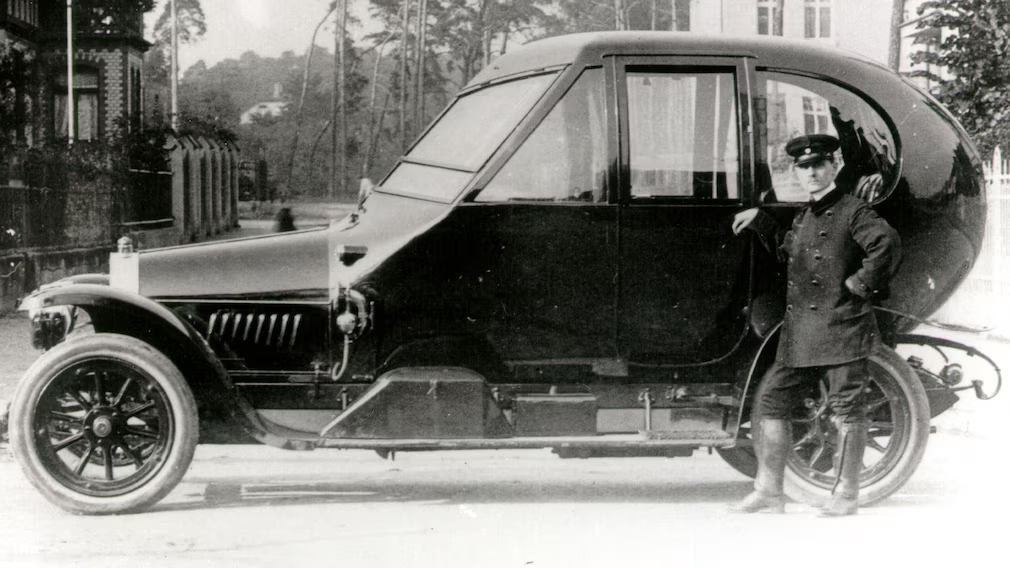
In 1912, automobiles were still uncommon outside major cities, and most were open-top. Even enclosed cars usually relied on fabric roofs or simple wooden tops. Max Lochner’s creation from Aachen was something else entirely. It had a normal car nose up front and a tall, rounded, windowed shell behind it. Contemporary accounts describe it as a red-painted metal egg that looked like a little rolling house.
Lochner’s goal was not a gimmick. He believed a smoother, more aerodynamic body could make a car faster and more economical without changing the engine. That thinking was far from typical in 1912. Lochner, an inventor with prior patents and an interest in aviation through his brother Erich, designed the custom body and had it built at the Opel factory. The reported cost was 120,000 marks, which would be just shy of $1 million today.
Under the body sat an Opel 13/30 PS with a 3.3-liter engine rated at 30 horsepower. In standard trim it topped out around 44 mph. With the streamlined egg body, it was said to reach about 60 mph, roughly a 35 percent gain. One story says the chauffeur, Mr. Heil, opened the split windshield on a fast run and the wind blew passengers’ top hats away.
No known body drawings survive, so researchers estimate dimensions from tire size and a photograph. That same photo informed the design of the 1:43 model, which is still in prototype stage.

The car disappeared after being requisitioned for the war effort in 1914, and only the one photograph above is widely referenced. That scarcity is why Thorsten Sabrautzky of Autopioneer & Brausi is drawing attention with a 1:43 resin model due later this spring, limited to 50 pieces and priced around $300 plus shipping.
This topic was modified 4 months ago 2 times by Randy Rusk

04/02/2026 10:27 pm
...there may have been pragmatic reasoning behind this design, justify its highly polarizing style. However, it's, IMO, far from elegant. It's great there's a scale model of it though...but should it be red? 🤔 🤨

05/02/2026 2:46 am
I just love oddball car design, and histories! thanks Randy

05/02/2026 8:41 am
L’Oeuf Électrique came out many years later - I bet the French designer never saw this Opel though!


It does remind me of the 1914 ALFA 40/60 HP (pre-Romeo) designed for Count Ricotti, except that he started at the front!


(first photo - internet)

05/02/2026 8:51 am
Love the picture and writeup Randy. I'm guessing Mr. Heil, the chauffeur, caught Hell.

07/02/2026 10:14 pm
Streamlining appeared much earlier, as land speed record contenders recognized wind resistance early on. Jenatzy in 1899 and Baker Electric in 1902.

