The Diecast Zone · Model Car Club Since 1994
Diecast Collector Forums
Eight forums, every scale, and thirty years of shop talk — new arrivals, restorations, reviews, and the finds you won’t see posted anywhere else, with the full archive back to 2002 restored and searchable. Free to Register.
8Forums
195,000+Topics
1,276,000+Posts
10,000+Members
Notifications
Clear all
Model-Related Handicrafts
7
Posts
7
Users
13
Reactions
1,412
Views


Topic starter
12/07/2024 8:49 am

I thought the front-end styling idea originally proposed for the 1960 Edsels quite appealing, and decided to try and reproduce one of the prototypes in 1:43. Most people will find the following account of the build process so boring they could lose the will to live, but I felt sure there are folks out there who might find the details interesting. I dedicate this post to both of them.
The obvious starting point - the only possible starting point, really - was the Brooklin convertible.

I got an unboxed specimen quite cheaply online, and the first move was to scratchbuild a roof. Marking out a complete roof and its pillars on a flat piece of metal can be tricky, because if the roof is domed and has quite heavily radiused side edges it’s hard to know just how much allowance to make for that and the roof ends up a little too narrow or too wide. So I cut two mirror-image halves, so the final width could be fine-tuned by either filing along the centreline or leaving a small gap to be filled later.

The front of the roof was conveniently glued to the built-in sun visors, small tabs at the base of the rear pillars tied into notches in the lower body, and a reinforcing strip went down the join line (on the inside, obviously). A rear window frame was shaped from thin brass rod and the roof was smoothed with fine filler.


The large and curvy rear window was my usual trick of a balsa carving push-moulded into heated plastic. Hadn’t done one of those for quite a while, so I had a couple of poorly-fitting moulds before I stepped up the concentration a couple of notches and got a decent one.

The raised centre section of the bonnet/hood is filler, with a thin polystyrene strip for the central rib. No problem there, apart from changing my mind several times about quite how “bold” or subtle the raised section needed to be. I thought I had judged it about right, but looking at the pictures now, I may not have made the "beak" quite pointy enough. Ho hum, you try your best but there's always a small screw-up somewhere along the line.
Now to the front grillework. Hmmm. Quite a lot of new detail to fit in quite a small space, so a bit of careful measuring was called for, using a photo scaled to 4 times the model width.

The fancy chrome trim pieces on the front fender edges were cast by Brooklin in one piece with the grille, so had to be sawn off and glued back on separately. The new chrome grille surrounds were made from 2 mm wide strips sawn from 0.5 mm thick aluminium sheet. Nice and soft and easy to work, and if you don’t get the bends in the right place it can be straightened and re-bent quite a few times before the metal eventually starts to fatigue and craze. The chrome surround that frames the centre “spike” slants forwards from the rest of the grille, so that needed a separate tapered aluminium piece.
The centre spike was shaped from a scrap of plastic and its side ribs are pieces of very thin polystyrene “straw”. It was originally going to be a separate item, to be installed during final assembly, but because of the way it is blended into the bumper I decided it needed to be part of the bumper. For added strength during handling I drilled a vertical hole through the bumper and into the base of the spike and glued in a small metal pin. Blending at the base was done with JB Kwik-Weld.

I have some photo-etched brass meshes made by Scale Link, and by great good luck one of them gave a pretty decent mesh size for the two side grilles (5 mm high x 18.5 mm wide).
Headlamps are 3 mm “jewel” lamps and their bright surrounds are thin slices of 4 mm aluminium tube.


The side “flashes” were cut from a sheet of what they call “lenticular” plastic, the finely-ribbed material they use to make 3D postcards or those cards where an eye winks at you or lips blow a kiss.
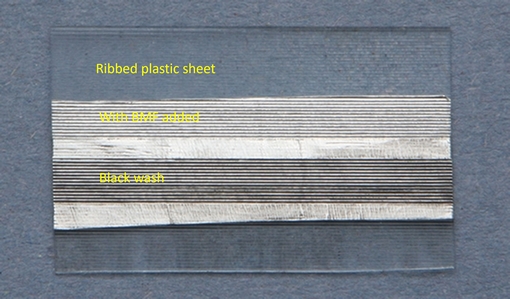
You can still find them in shops, and the image can be easily soaked off with something like cellulose thinners or acetone to reveal the clear plastic. Very useful for grillework and trim, but surprisingly difficult to cut cleanly. I made a brass template of the lower edge of the flash and clamped it onto the plastic, then set to work with a fresh No 11 Exacto blade. My first finished efforts were far too wide and clumsy-looking. Attempts to trim them with scissors or sandpaper got very untidy, and the upper beading above the ribbing - plastic rod attached to the ribbed plastic with superglue - didn’t tolerate handling or trimming very well (i.e. the bastards kept coming loose). My big mistake was to persist with reproducing that beading. At this scale that could have safely been omitted to produce a neater result, but you know how it is, you see a detail and think you should include it. The finished articles are my fourth attempt. Still not perfect, but last-minute attempts at further improvements could have been disastrous and I decided to leave well alone.
The original Edsel nameplates on the rear flanks had to be filed off to accommodate those side flashes. I tried replacing them with waterslide letters but they were too small and didn’t show up well on the dark paint, so I put five little dots on each side with a silver pen. (Well, to be honest, I put SIX little dots on each side, but corrected myself just in time). I don’t know if the Edsel name was also going to appear somewhere on the nose but there’s no sign of it on the prototypes.
I left the interior as it was, and kept the original Brooklin wheels, but I thought their whitewalls were maybe just a touch too wide for 1960 so I found a slightly narrower set that fitted the wheels.
The paintwork on the Canadian replica was claimed to match the prototype, but various photos of the prototype and the replica seem to vary from a fairly light, almost lilac blue (maybe faded photos?) to a dark metallic. In the end I chose a fairly generic metallic blue which turned out to be somewhere between the two. The roof is Ford Diamond White.
There was nothing wrong with the original Brookin brightwork, but to match up with my new chrome bits I re-did everything with BMF “New Improved Chrome”, which I think was a replacement for their “Ultra Bright Chrome” which was a brittle nightmare to work with. It worked fine but, oh boy, the scalpel work is hell on the nerves and had to be done in stages, with a few wobbles and a lot of cursing along the way.
Finally it all went together. I’m not entirely happy with it. Some of my techniques were a bit rusty, resulting in a number of pretty rough initial moves that needed more remedial work than one would wish, and there are still a few untidy bits here and there, but it’s a model I really wanted to do and I was just happy to get it knocked it into shape (more or less) in the end.
You may have noticed that amazingly, despite all the hours I spent looking at the photos, I entirely missed the fact that rear wheel skirts were fitted. Ah well, I don’t like those things anyway, and I’m sure they would have been optional.


Are those roars of appreciation I hear, or the ominous sound of severe sleep apnoea? It could go either way.
Graeme.M. Ogg
London U.K.

12/07/2024 10:04 am
Thanks for this process tutorial Graeme, I found it very interesting!
Christopher Moroni and John Kuvakas reacted

12/07/2024 5:07 pm
You are indeed very talented Graeme. Thanks for sharing this fine build with us.
Christopher Moroni and John Kuvakas reacted


13/07/2024 3:56 pm
I'm always amazed at your capability to make something really cool out of a mediocre model. Very nice work, Graeme. Thanks for putting the tutorial together.
John Kuvakas
Warrenton, VA
Christopher Moroni and Geoff Jowett reacted

14/07/2024 2:10 am
thats amazing Graeme. Your creative use of diverse materials is really impressive. Well done sir!
Christopher Moroni reacted

15/07/2024 5:35 am
Thanks for posting the tutorial. Very well presented. You have done an amazing job and should be very proud of the finished product. I am especially impressed by your use of brass. I find modifying Brooklins more enjoyable than the actual collecting. Keep up your creativity and as always, remember that all obstacles can be overcome with imagination and determination.
Christopher Moroni reacted

22/07/2024 11:14 am
Great work Graeme, I enjoyed your "how-to" post very much! I need to fabricate, in the way you did, some 1/18 "glass" but I'm too lazy to make the wooden molds. One day I will, and I hope my "glass" turns out as good as your "glass."