The Diecast Zone · Model Car Club Since 1997
Diecast Collector Forums
Eight forums, every scale, and thirty years of shop talk — new arrivals, restorations, reviews, and the finds you won’t see posted anywhere else, with the full archive back to 2002 restored and searchable. Free to Register.
8Forums
195,000+Topics
1,276,000+Posts
10,000+Members
1997Research From
Notifications
Clear all


Topic starter
22/09/2025 4:44 pm


John Kuvakas
Warrenton, VA

22/09/2025 4:57 pm
Looks sharp. Probably a half a million dollar car.

22/09/2025 5:46 pm
...we'll never know.
Many "aficionados" attribute the fall of Detroit and "Big 3" with the influx of "Jap-crap" in the late 1960's / early '70's In reality, however, Detroit's decline started when Packard/Hudson collapsed.
By all rights.... Packard, Hudson, Studebaker, Olds, Pontiac, Plymouth, etc... should've have thrived and remained solvent to this day - but they all "goofed," gave away market share, and "handed" billions in profits to other countries.
So... yeah - there should be a 2026 Packard, and yeah, it could've looked much like this.
We'll never know.

22/09/2025 5:59 pm
It is an interesting and attractive design study of this automobile. Wish they could have stuck around !

22/09/2025 6:46 pm
Many businesses have failed over the last sixty years due to misreading what the public wanted. For several decades now, companies have brought in MBAs with little or no experience in the field they're hired into without the ability to read trends that occur. As a consequence they end up throwing the baby out with the bath water resulting in the products that produce cash flow are no longer there.

22/09/2025 8:46 pm
My understanding is that this has been built, it’s based on a Bentley…my only critique is that there’s something not right in that grille & headlight design…
Zeeky Banutski
The People’s Republic of Maryland

22/09/2025 9:00 pm
Many businesses have failed over the last sixty years due to misreading what the public wanted.
spot on Bob. Kodak is of course the textbook case. Here in Melbourne we had a commercial contemporary music radio station, 3XY, that dominated ratings from the late 60s to early 80s, and they deserved to. Creative, innovative, who from my vintage in Melbourne will ever forget Rocktober?! Early mid 80s FM licenses became available. 3XY management, nah thats just a gimmick, wont last. 3XY gone within a couple of years of FM radio starting up. Remarkable misread after setting trends for nearly 2 decades.

22/09/2025 11:13 pm
Nice but it's outside my paygrade.
John Bono
North Jersey

23/09/2025 6:39 am
That's the nicest KIA I have seen to date.
Terry's right to see the Bentley cues in the car. I see late 50's - early 60's styling hints in the car with totally modern finishes. Yet, there's that unmistakable Packard-shouldered grill. About the only thing 'Packard' that is visible.
A beautiful styling exercise.

23/09/2025 8:34 am
I think those here that have hinted to the Big Three being blind to the invasion of the Japanese cars is pretty spot on. And I also agree that the Big Three's decline was due in some part to the Hudson, Nash, Packard, Studebaker collapse.
But I also see some other unspoken reasons the Big Three have become a shell of their former selves.
The first reason I think is the most important one, and that is they fought within their own companies. What I'm saying here is that (for example with GM), each brand had their own division, but those brands were in competition with each other.
In other words, Chevrolet wanted to beat out Pontiac and vice-versa throughout the company. None of the GM brands should have ever been trying to outdo the other. All their cars should have been on equal ground, so if they sold any of their brands, it was a win for the company, NOT the division. Then if a brand didn't sell well or at all, that would have been a reason to dump it.
Another important overlooked issue within each division is that every brand was in competition with itself. By this I mean, (and again using Chevy as the example) if you looked at a Chevy, they had umpteen different Chevy's to choose from within the division. My thinking has always been that the GM step-ladder of brands should have been just that.
If a buy wanted an entry level, low-priced car, they bought a Chevy. If their taste and pocketbook wanted a little bit more, they moved to the Pontiac, and so on to the Oldsmobile, Buick, and eventually the top of the mountain with a Cadillac.
And each brand would offer something a little more elite than the brand under it. Now being fair, in a sense that was the mindset of the 5 division in GM, but they should not have had those umpteen choices in each division. That is what I feel caused their problems.
This same business model should have been adhered to at FoMoCo and Chrysler Corp. back in the day. And yes by all means, the brain trusts of Hudson, Nash, Packard, and Studebaker should have checked their individual egos at the door and merged to create a 4th powerhouse company. But they couldn't because each head of their respective companies wanted to be chief.
I don't know if anything I've just said here was the answer or even if it makes sense, but it's my take on it.
George Schire
Oakdale, Minnesota
23/09/2025 8:49 am
@georgeschire When considering your positions George you must remember that The Big 3 did, for many years, in fact perform quite successfully, essentially as you outlined. The problem was that they stuck to it. That is, they failed to adapt to changing market conditions. Their aim was right, but the target moved.
23/09/2025 9:00 am
@georgeschire When considering your positions George you must remember that The Big 3 did, for many years, in fact perform quite successfully, essentially as you outlined. The problem was that they stuck to it. That is, they failed to adapt to changing market conditions. Their aim was right, but the target moved.
I think it's safe to say that GM (and the others) didn't see the train coming down the track. And they became complacent, thinking what they were doing was okay, so why change it. In the end, they were eaten by the enemy. And when you see how GM killed both Pontiac and Oldsmobile, it doesn't take a brain surgeon to see that they had no clue what they were doing. Both those Brands were top performing divisions for the company for decades, and in fact probably better than their sister divisions of Chevy, Buick, and Cadillac. And the same held true for Chrysler Corp. Their Plymouth was the "bread and butter" car for decades, and it still should be. Ditto for Ford with their Mercury. It was a great in-between car for a Ford owner to get to a Lincoln.
George Schire
Oakdale, Minnesota
Topic starter
23/09/2025 10:11 am
These are all good points about the Big 3. But, in the end, it was the bean counters that surrendered the market to outside competition. It is correct that the major domestic manufacturers got complacent. The die-off in the fifties occurred because there were too many makers in a market that rewarded only those who could innovate and keep up with technology that was advancing at a lightning speed. Those who survived the inevitable contraction (there was a huge capacity for over-production) widely invested in setting trends rather than following them. The Big Three survived because they set the level and took the risks.
Then came the bean counters in the mid-to-late fifties. You can see the impact they had early on with platforms and designs, particularly in the case of GM, being more similar than distinguished. The design philosophy seemed ot be, "Build three sizes, change the trim here and there, put a unique engine in it and a long-standing nameplate, and encourage people to maintain brand loyalty."

In their pursuit of wringing every nickel of profit out of each sale, the platforms and eventually the designs began to homogenize. This was OK, at first. But while the import manufacturers continued to innovate and improve, the Big Three began to languish. The pursuit of profits began to compromise quality and durability. By the early 1970s, instead of leading new technology, domestic makers began to apply Band-Aids to drivetrains to meet new emission regulations. They wasted so many resources trying to keep up and maintain margins, designs and build quality further suffered. BY the end of the seventies, Japan and Germany were the market leaders in quality and engineering, with Japan squashing everyone else in value. For Japan, this was by design. They forsake profits in the short run for a larger slice of the pie in the long run. Unsurprisingly, the public noticed and lost interest in maintaining loyalty to domestic producers.
The Big Three, instead of adjusting to all this, doubled down on profits. Designs and platforms became further homogenized, making it increasingly difficult to distinguish between the nameplates. By the early nineties, it didn't really matter whether you bought an Olds or a Pontiac, a Ford or a Mercury, A Dodge or a Plymouth, they were all the same. Yes, each division had maybe one model that was kinda their own. But those were niche models hardly able to carry an entire division. So, after eroding their market share for a few decades, the Big Three found themselves in financial trouble, and they finally had to reevaluate their various divisions, most of which had become Xerox copies of one another.
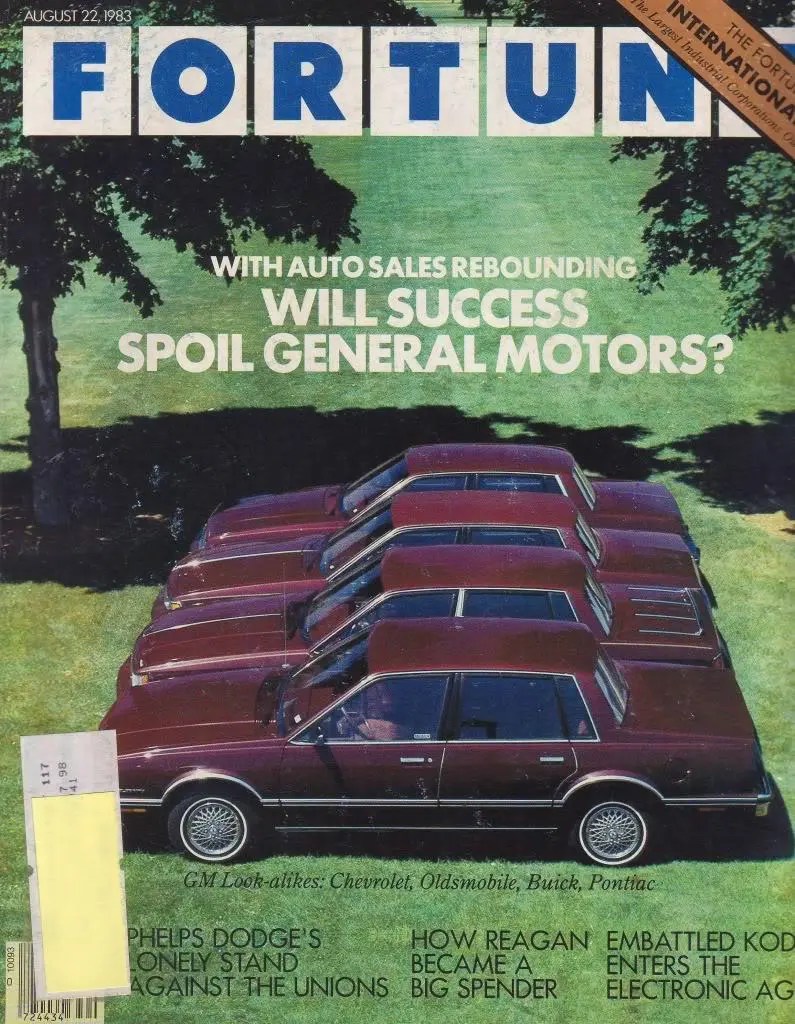
George is right, Pontiac, Oldsmobile, and Plymouth were successful for decades. However, by the time of their demise, they were floundering, with little to offer of what had originally made them unique. It was essentially a repeat of the mistakes made by Packard, Hudson, Studebaker, and others in the 1950s.
The only thing these companies were victims of was attempted suicide.
John Kuvakas
Warrenton, VA

23/09/2025 10:22 am
23/09/2025 1:32 pm
...as recently as 2009, GM was still "world's largest." In addition to everything else noted, trying to change the culture, or "the old boy network" remains as one of GM's most challenging obstacles. As John noted, once the bean counter's forecasted projections proved-out profits, all else is forgiven or brushed aside....as GM incrementally shrinks year after year...
John Kuvakas and Tony Perrone reacted
Page 1 / 2
Next